Revolutionizing Bone Health and Musculoskeletal Strength: A Comprehensive Guide to OsteoStrong Dallas
As humans age, the quiet erosion of skeletal health often goes unnoticed until a minor stumble results in a major fracture. Conditions like osteopenia and osteoporosis affect millions of individuals worldwide, turning daily movements into underlying hazards. Traditionally, the medical community has relied heavily on pharmaceuticals—such as bisphosphonates—alongside traditional weight-bearing exercises to manage declining bone mineral density (BMD). While these conventional treatments have their place, they frequently come with complex decision-making processes regarding side effects, and traditional gym workouts rarely deliver the intense mechanical force required to effectively stimulate new bone growth safely.
Enter a paradigm shift in physical wellness: OsteoStrong. Operating specialized centers across the globe—including prominent locations like OsteoStrong Dallas Galleria and OsteoStrong Midtown Dallas—this membership-based integrative health and wellness center focuses exclusively on musculoskeletal strengthening. By utilizing a robotic musculoskeletal development system rather than traditional weights, OsteoStrong offers a sweat-free, low-risk, and remarkably fast approach to optimizing skeletal integrity, improving balance, and alleviating joint pain.
Understanding the Skeleton: The Foundation of Human Health
The human skeletal system is far more than an inert framework designed simply to hold the body upright. It is a living, dynamic organ system responsible for structural support, protection of vital organs, red and white blood cell production, and mineral storage. Yet, because bone tissue undergoes a continuous cycle of breakdown (resorption) and rebuilding (formation), it is vulnerable to imbalance.
As people enter middle age and beyond—particularly women navigating menopause—bone resorption frequently outpaces bone formation. This leads to a systemic loss of density, weakening the structural lattice of the bones.
Osteopenia marks the early warning stage where bone density is lower than normal but not yet low enough to be classified as osteoporosis.
Osteoporosis represents an advanced stage characterized by porous, brittle bones that are profoundly susceptible to fractures from minimal stress or routine falls.
Statistically, the impact is staggering: roughly half of all women and up to a quarter of men over the age of 50 will experience a fracture due to osteoporosis. Preventing this decline requires a stimulus powerful enough to signal the body to generate new bone tissue.
The Science of Osteogenic Loading
To understand how OsteoStrong functions, one must examine the fundamental science of bone adaptation, often referred to as osteogenic loading.
The Threshold of Bone Growth
Decades of biomechanical research have demonstrated that bone tissue responds dynamically to mechanical strain. In the late 19th century, Wolff’s Law established that bone adapts under the stress placed upon it. Modern physiological studies have expanded on this, identifying that the minimum threshold of force required to trigger osteogenesis (the creation of new bone tissue) in the hip joint is roughly 4.2 multiples of body weight.
Achieving this magnitude of force naturally through standard physical activity or high-impact exercise is difficult and risky for adults. High-impact activities—such as heavy jumping, sprinting, or heavy barbell squats—place immense stress on joints, tendons, and ligaments, frequently leading to acute injuries or chronic joint degradation in aging populations. Consequently, adults naturally avoid high-impact movements, causing their skeletal systems to gradually atrophy from lack of adequate mechanical stimulus.
High-Impact Emulation
OsteoStrong solves this dilemma through high-impact emulation. Rather than subjecting the body to the kinetic shock of actual high-impact collisions or heavy free weights, the system uses specialized robotic equipment to allow individuals to safely exert massive amounts of force in optimal biomechanical positions.
Under these conditions, a member can comfortably and safely produce compressive loads exceeding 5 to 12 times their body weight. This brief, intense neurological and mechanical trigger convinces the central nervous system that the skeletal system is undergoing extreme stress, prompting the body to rapidly initiate bone mineral accrual and strengthen the surrounding connective tissues.
The OsteoStrong Experience: What Happens in a Session?
Unlike traditional fitness centers that demand hours of weekly exertion, heavy sweating, and post-workout fatigue, an OsteoStrong session takes less than 10 minutes once a week. The protocol is entirely sweat-free, non-invasive, and structured around a precise four-device circuit.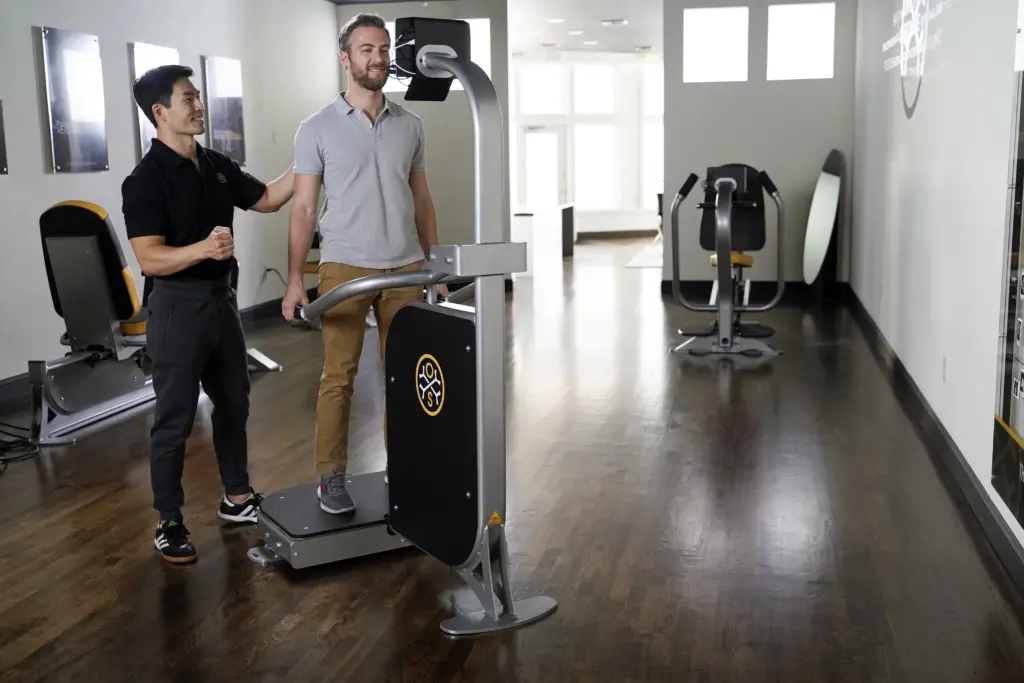
Step 1: Whole-Body Vibration (VibePlate)
Every session begins with a brief, two-minute stint on a whole-body vibration plate (typically set at around 30 Hz). Standing on this vibrating platform serves several critical physiological purposes:
Enhances neuromuscular communication, priming the central nervous system.
Stimulates proprioception, which directly benefits balance and coordination.
Relaxes tight muscle fibers and increases localized blood circulation before loading.
Step 2: The Four-Device Robotic Circuit
Following vibration preparation, members transition to a circuit of four proprietary devices collectively known as the Spectrum System—the first class of Robotic Musculoskeletal Development Systems (RMDS). Guided by a trained session coach, the user positions themselves securely on each machine to target major skeletal groups:
The Upper Core / Chest Press: Focuses on the wrists, arms, shoulders, and thoracic spine.
The Lower Core / Core Pull: Emulates pulling forces to stimulate posture-supporting bones and muscles.
The Leg Press: Delivers high axial compression forces through the hips, femur, and spine—the primary sites for osteoporotic fractures.
The Postural DLS (Dynamic Loading System): Targets the entire posterior chain and spine alignment.
On each device, the user engages in a slow, controlled, self-loaded movement, pushing or pulling against an immovable resistance barrier for roughly five to ten seconds. Instant digital biofeedback displays the force exerted in pounds and multiples of body weight on a screen, allowing members to track their immediate power output.
Inside OsteoStrong Dallas: Community, Locations, and Modalities
For residents across the Metroplex, accessing these advanced protocols is seamless. Centers like OsteoStrong Dallas Galleria (situated on Dallas Parkway) and OsteoStrong Midtown Dallas serve as dedicated wellness hubs for individuals looking to take control of their physical longevity.
Personalized Tracking and Accountability
One of the hallmarks of the Dallas locations is their data-driven approach. Following every weekly session, comprehensive reports are generated and logged, detailing exact force metrics, progress trends over time, and improvements in balance or power output. Members frequently bring in their routine DEXA (Dual-Energy X-ray Absorptiometry) scans from their primary physicians to map long-term changes in bone mineral density (BMD), often reporting notable stabilization or reversal from osteoporosis back to osteopenia over 12 to 18 months of consistent membership.
Complementary Wellness Modalities
Beyond the core skeletal strengthening circuit, Dallas centers often integrate supplementary bio-hacking and recovery modalities designed to enhance overall vitality. Depending on the specific location, members can access:
Hydromassage therapy for deep muscle relaxation and stress relief.
Pulsed Electromagnetic Field (PEMF) therapy to support cellular recovery.
Red light therapy for skin health and joint inflammation reduction.
Advanced balance and agility training tools.
Who Can Benefit from OsteoStrong?
Because the system adapts entirely to the user's individual capabilities—whether they are an elite athlete or an 85-year-old dealing with severe bone loss—the demographic profile of an OsteoStrong member is remarkably broad:
Post-Menopausal Women: The primary group affected by rapid estrogen-related bone density decline.
Individuals with Osteopenia or Osteoporosis: Looking for a non-pharmaceutical intervention or a complementary protocol to enhance traditional medical therapies safely.
Fall-Risk and Aging Populations: Seeking to build core stability, leg strength, and superior balance to prevent life-altering falls.
Athletes and Fitness Enthusiasts: Aiming to maximize structural strength, force production, and overall physical performance without risking joint wear-and-tear.
Desk Workers and Individuals with Chronic Pain: Suffering from poor posture, lower back aches, or joint stiffness due to sedentary lifestyles.
Safety, Efficacy, and Medical Integration
It is important to understand that OsteoStrong is not a medical facility, gym, or physical therapy clinic, nor does it diagnose or treat diseases directly. Instead, it functions as an educational and musculoskeletal fitness center.
While no physical conditioning protocol is entirely free of risk, the controlled, robotic positioning used by OsteoStrong eliminates the velocity, momentum, and instability hazards associated with free weights or high-impact plyometrics. Sessions are always supervised by certified session coaches who ensure proper form, controlled breathing, and gradual exertion limits ("easing in and easing out" of every movement).
For patients currently managed by endocrinologists or rheumatologists for severe bone loss, OsteoStrong serves as an ideal adjunct. It bridges the gap between passive pharmaceutical consumption and active physical health, empowering individuals to take an active role in rebuilding their body's primary structural foundation.
Conclusion
Skeletal health dictates our physical independence, mobility, and quality of life as we age. Ignoring the silent progression of bone density loss can lead to severe consequences, but modern technological innovations offer a proactive path forward. Through the principles of osteogenic loading and high-impact emulation, centers like OsteoStrong Dallas provide a fast, safe, and scientifically grounded method to reclaim skeletal strength, improve balance, and reduce joint discomfort.
Requiring just a single 10-minute session per week without sweat or strain, it stands as a powerful tool for anyone ready to future-proof their body, protect their independence, and build a stronger foundation for the years ahead.

Comments
Post a Comment